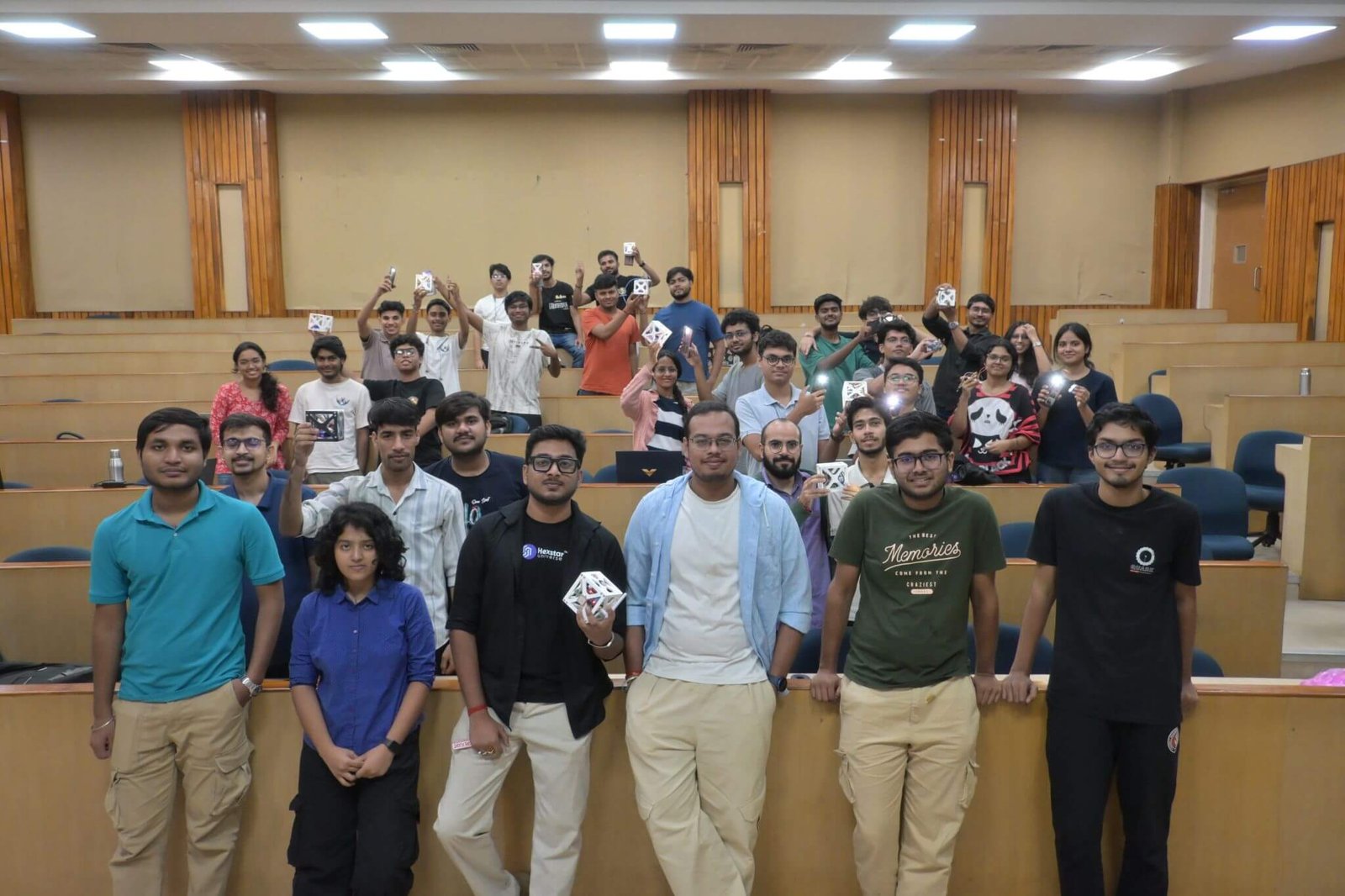
A CubeSat workshop is a hands-on session where students assemble a small satellite kit, connect its sensors and radio, and watch live data on a ground-station dashboard. Hexstar Universe has run these workshops for schools, universities and space agencies in India, Bahrain and Oman. Students need no prior experience.
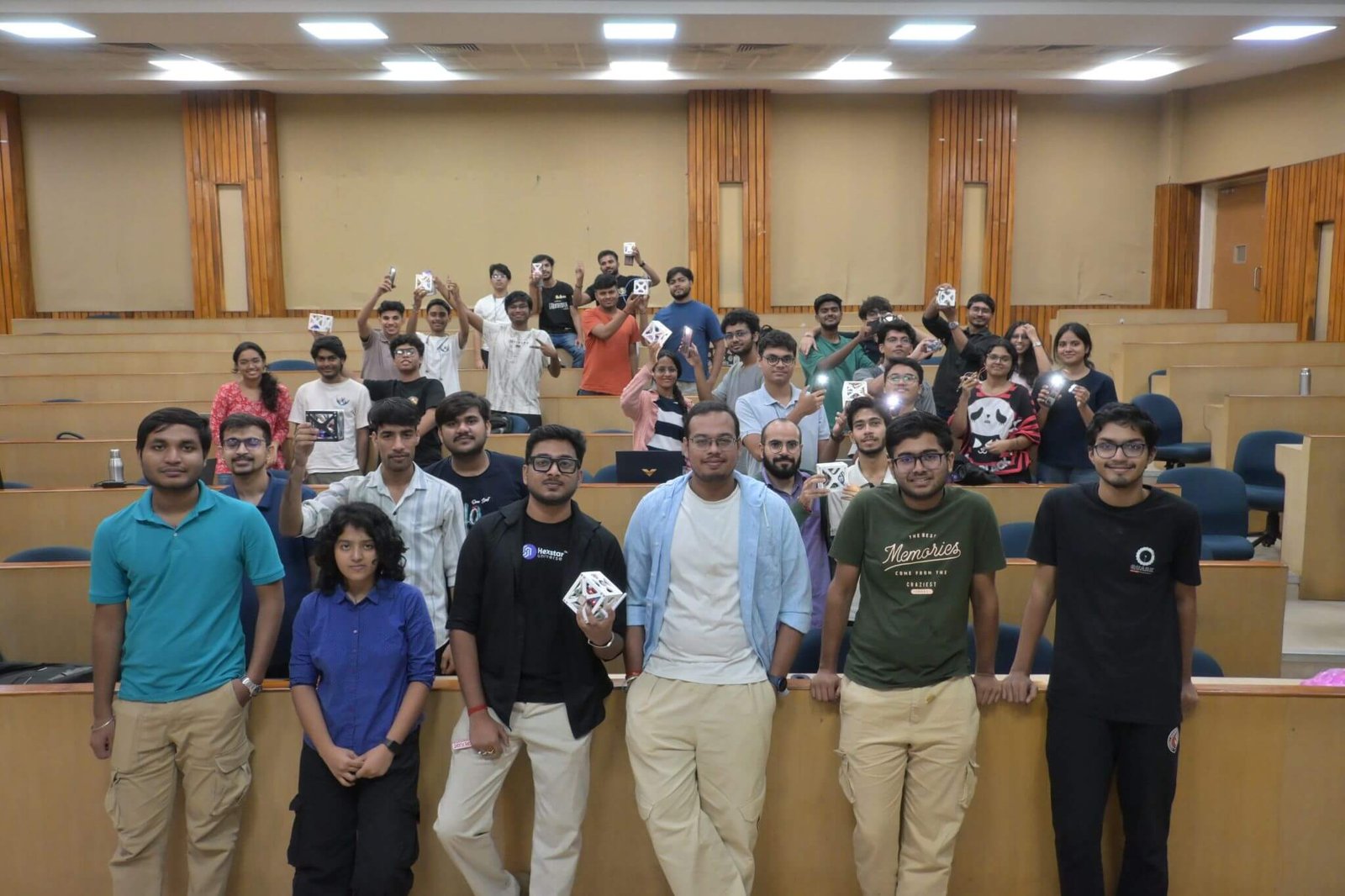
Most students learn about space from slides. In a CubeSat workshop, they build it. At IIT Kharagpur, 50+ students built and tested 30 satellite kits from scratch. At Geetanjali Institute of Technical Studies, 245+ students built 20+ CubeSats and sent them to the stratosphere. In Coimbatore, Class 8 and 9 students collected live data from their own kit.
This guide explains what a CubeSat workshop is, what students build, what they learn, and how your school, college or club can host one.
[Add photo: hero image of students holding CubeSat kits]
See all images and videos from our workshops: visit the gallery
What Is a CubeSat?
A CubeSat is a small, standardised satellite built from cube-shaped units. One unit, called 1U, measures 10 x 10 x 10 cm. Universities, startups and space agencies use CubeSats because they make real space missions affordable for small teams. Learn more at CubeSat.org and in NASA’s guide to SmallSats and CubeSats.
What Is a CubeSat Workshop?
A CubeSat workshop brings that mission workflow into a classroom or lab. Each team gets an educational CubeSat kit with a structure, onboard electronics, sensors and a wireless link to a ground station.
The kit is a table-top and field-friendly learning platform. It copies the architecture and workflow of a satellite mission. It is not an orbital satellite. That is why it is safe, affordable and ready to use in any classroom, and why it is the best first step before a real orbital mission.
What Do Students Build in a CubeSat Workshop?
[Add photo: students assembling CubeSat kits at a workshop]
See all images and videos from our workshops: visit the gallery
Every workshop follows the same four stages as a real satellite mission.
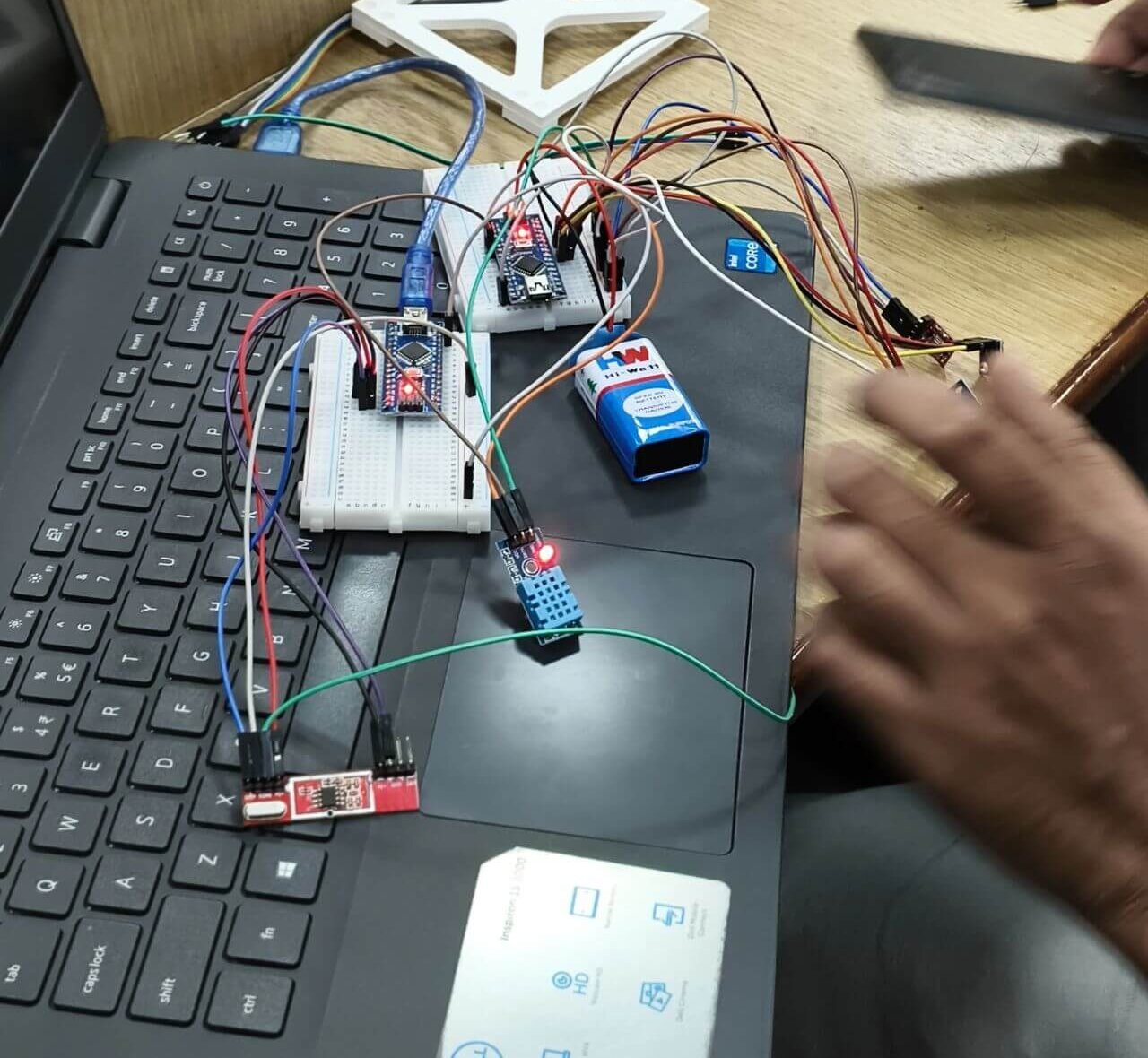
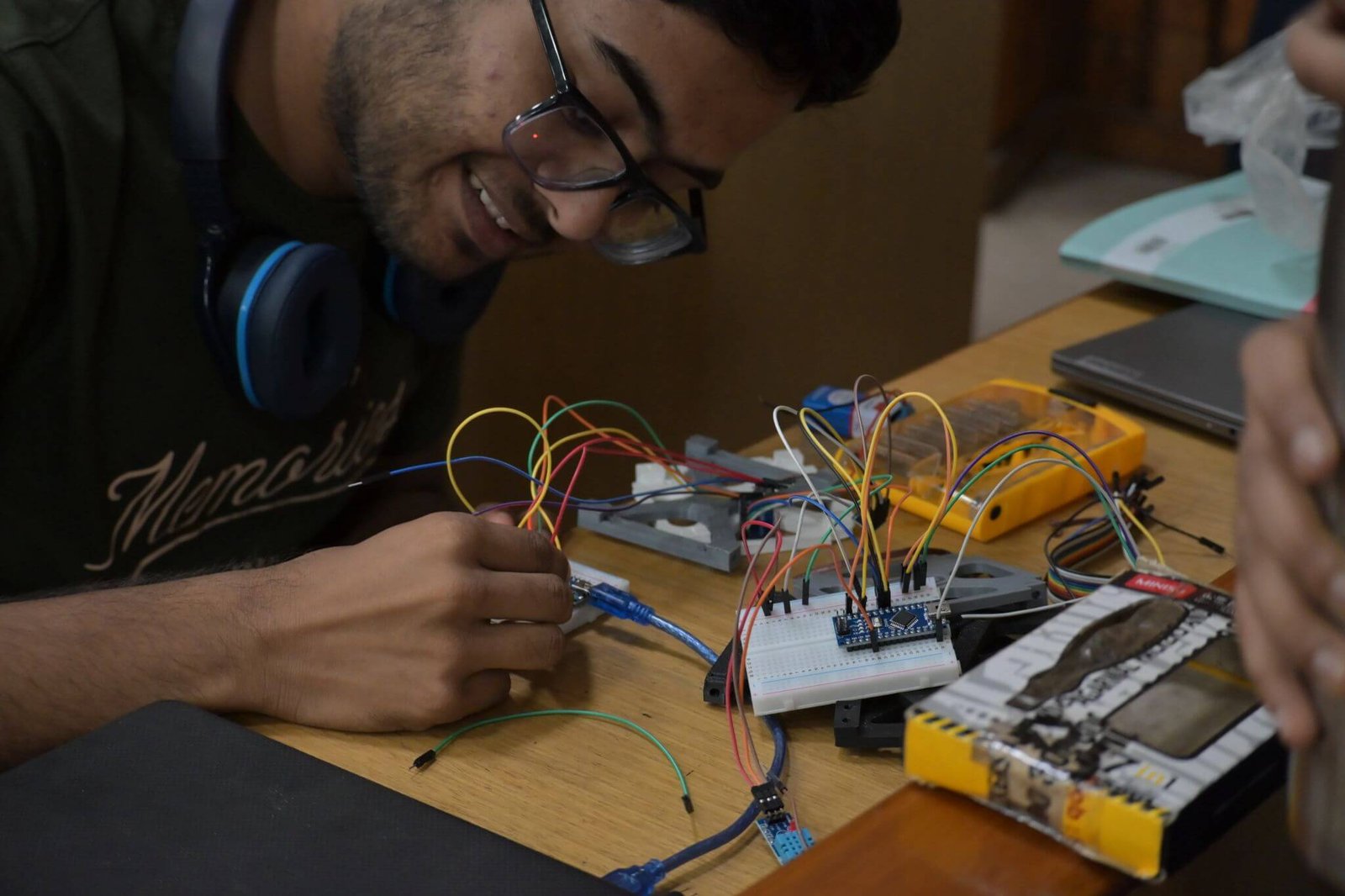
- Assemble. Students put together the satellite structure and onboard electronics, and learn how each subsystem fits.
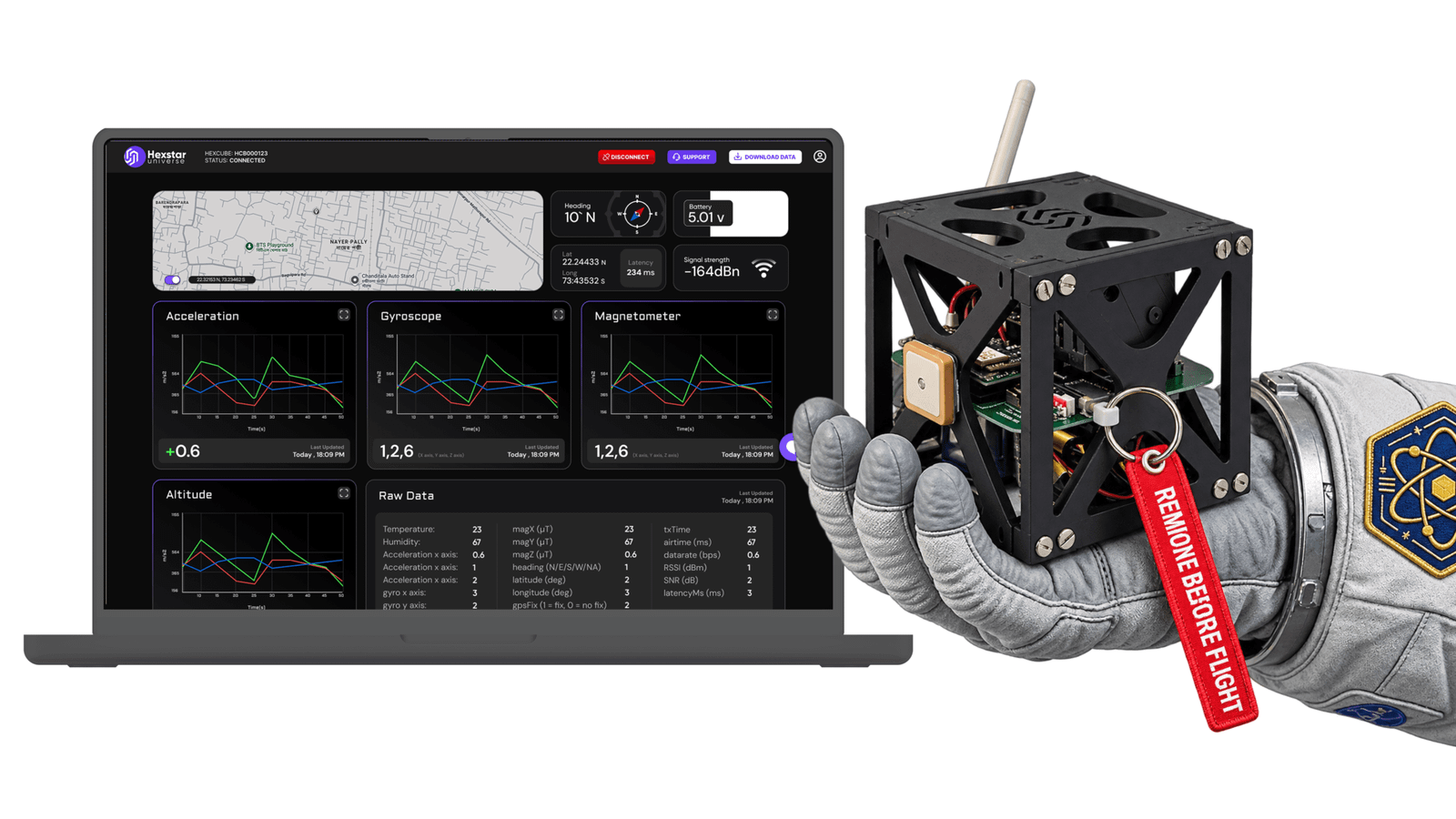
- Integrate. They connect power, sensors and communication. The kit measures temperature, humidity, pressure and altitude, plus acceleration and rotation. Some kit versions add GPS. Students see how a satellite senses its surroundings.
- Communicate. They set up a LoRa 433 MHz radio link, receive live telemetry on a ground station and plot it in real time.
- Test on the dashboard. Each team checks its build on the Hexstar Universe mission-control dashboard, which shows live graphs, orientation, motion and raw sensor data.
[Add photo: live telemetry dashboard on a student laptop]
See all images and videos: visit the gallery
Optional: launch. Any workshop can grow into a supervised balloon launch. Students prepare the payload, run pre-launch checks, collect flight data and analyse the results.
[Add photo: high-altitude balloon launch with a CubeSat]
See all images and videos of our balloon launches: visit the gallery
What Do Students Learn?
- How a satellite’s subsystems work together: structure, power, sensing and communication
- How to wire, code and debug real sensors and electronics
- How a wireless telemetry link and ground station work
- How to read, plot and explain live mission data
- How to work in a team the way a mission team does
Most kits stop at wiring and code. Ours add a mission-style dashboard, so students learn to read data as well as make it. The results can go straight into a project report or portfolio.
CubeSat Workshops We Have Run Around the World
Hexstar Universe has taught the same format to primary school students, university undergraduates and working scientists. Here is a selection.
To see all the images and videos from every workshop, visit our gallery.
| Institution or event | Country | What happened |
|---|---|---|
| IIT Kharagpur | India | 50+ students built and tested 30 CubeSat kits on the live dashboard |
| IIT Guwahati | India | Every kit assembled and tested, a 100% successful build, hosted with Team Equinox |
| Geetanjali Institute of Technical Studies | India | 245+ students built 20+ CubeSats that were launched to the stratosphere. Billed as India’s biggest CubeSat workshop |
| Birla Vishwakarma Mahavidyalaya | India | 70+ students built 10+ CubeSats |
| Christ University, Dept. of ECE | India | 50+ students learned and tested CubeSat kits |
| Corporation school, Coimbatore | India | 20+ students from Classes 8 and 9 tested CubeSats and launched one by helium balloon. Covered on the front page of The New Indian Express |
| C-DOT | India | 5+ scientists joined a CubeSat training program |
| Bahrain Space Agency | Bahrain | 50+ students from Bahraini institutions joined a hands-on workshop |
| Madar Oman program | Oman | CubeSat kits and software used in a training program run by ETCO Space with the Youth Center, Oman |
| FIRST LEGO League | Germany | Team Masch Misch used our Verner Kit and won the research category |
| Heritage Institute of Technology, Kolkata | India | We organised one of India’s biggest water rocket competitions in 2023 |
Case Study 1: 30 CubeSats in One Day at IIT Kharagpur
[Add photo: IIT Kharagpur students with their CubeSat kits]
More than 50 engineering students worked with 30 kits. They assembled the hardware, integrated sensors, set up the LoRa link and tested each build on the dashboard. The lesson for organisers: a build-and-test format keeps every team busy and gives each one a result they can show. Read the full story: IIT Kharagpur students build 30 CubeSats.
See all images and videos from IIT Kharagpur and other workshops: visit the gallery
Case Study 2: India’s Biggest CubeSat Workshop at GITS
[Add photo: GITS students and the balloon launch]
At Geetanjali Institute of Technical Studies, 245+ students joined and built 20+ CubeSats. The program ended with launches to the stratosphere. It shows that the format scales from a single lab to a whole campus.
See all images and videos from GITS: visit the gallery
Case Study 3: School Students in Coimbatore
[Add photo: Coimbatore school students with the CubeSat and balloon]
More than 20 students from Classes 8 and 9 explored satellite hardware, learned how sensors work and collected live data from a CubeSat. One kit was lifted by helium balloon. The local press covered it. It proves that young students can do real engineering when the activity is hands-on. Read more: School students in Coimbatore get hands-on with satellite technology.
See all images and videos from Coimbatore: visit the gallery
Case Study 4: IIT Guwahati, Christ University and More
[Add photo: IIT Guwahati or Christ University workshop]
At IIT Guwahati, every kit was assembled and tested, a 100% successful build, hosted with Team Equinox. At Christ University’s Department of ECE, 50+ students joined a hands-on satellite workshop.
See all images and videos from these workshops: visit the gallery
Case Study 5: Taking the Workshop Abroad
[Add photo: Bahrain or Oman workshop]
In Bahrain, 50+ students from different institutions joined a hands-on workshop linked to the Bahrain Space Agency. In Oman, Hexstar kits and software supported the Madar Oman training program organised by ETCO Space. Read more: From India to Oman.
See all images and videos from our global sessions: visit the gallery
Workshop Formats You Can Book
| Format | Best for | What happens |
|---|---|---|
| Build and test | Tech fests, department workshops, clubs | Teams assemble a kit, connect sensors, set up the radio link and test on the dashboard |
| Build, code and analyse | Engineering colleges, final-year students | Adds coding the on-board computer and analysing the data for a project report |
| Build and launch | Schools, universities, space clubs | Adds payload prep, pre-launch checks and a supervised balloon launch |
| Multi-day program | Institutions, space-sector skills programs | Extended hands-on training, such as the 10-day ETCO Space program |
| Faculty training | Teachers and lecturers | Teaches staff to run CubeSat sessions in their own curriculum |
Who Is a CubeSat Workshop For?
- Schools (ages 11+): a first, practical step into electronics, sensors and space science. Classes 8 and 9 have done it.
- Engineering colleges and universities: a project-ready lab session for ECE, CSE, instrumentation and aerospace students.
- Space clubs and robotics clubs: a team build with a real result and data to present.
- Tech fests and competitions: a headline event that every participant can try.
- Scientists and professionals: practical training on small satellite technology.
- Space agencies and youth programs: a ready, scalable format for national STEM and talent programs.
Why Hands-On Space Workshops Beat Lectures
Space science is taught widely. Space technology is rarely experienced. Many students reach college or an internship without working with real sensors, a radio link or live telemetry. That leaves a gap between what they know and what industry expects.
A hands-on workshop closes that gap in a few hours. Students build, run and read a real system, so the ideas stick. They also gain an end-to-end view of a mission and the confidence to enter the space sector.
The STEM Kits Behind Our Workshops
Every workshop uses Hexstar Universe kits. Every kit comes with setup and onboarding sessions, user manuals, technical support and help with experiment design and data analysis.
| Kit | Best for |
|---|---|
| CubeSat Kit Gen-1 | First-time learners and classroom basics |
| CubeSat Kit Gen-2 | University labs, space clubs and long-range telemetry |
| CubeSat Kit Gen-3 (AI) | Research, capstone projects and onboard AI |
| CanSat Kit | Competitions, outdoor deployment and recovery missions |
| Stratospheric Launch Kit (Verner Kit) | Near-space payloads and robotics team testing |
| Ground Station Kit | Tracking satellites and ground communication |
| Water Rocket Kit | School events, mass workshops and STEM fairs |
Want to build at home or in a lab without a workshop? See the CubeSat kit guide.
[Add photo: all CubeSat kits laid out together]
See all images and videos: visit the gallery
6 Workshop Ideas for Tech Fests and Competitions
- CubeSat build-and-test. Every participant builds a kit and tests it live.
- CanSat competition. Teams design a payload, deploy it, recover it and report the mission.
- Water rocket contest. It scales to large groups and teaches stability and design.
- Stratospheric balloon launch. A workshop becomes a full launch mission with real flight data.
- Robotics plus space add-on. Sensor experiments that extend an existing robotics program.
- Ground station challenge. Timed teams track and talk to a satellite.
We also offer faculty training, custom dashboards for your institution, and help to prepare for ISRO and IN-SPACe challenges, CanSat and CubeSat competitions.
Our Track Record
- 21 institutions worked with
- 25 workshops conducted
- 926+ students trained
- 1,000+ CubeSat kits delivered
- Kits in 91 countries
- Kits bought by organisations including the University of Oxford, IIT Madras, IIT Hyderabad, C-DOT and the Bahrain Space Agency
See the proof in photos and videos: visit the gallery.
How to Book a CubeSat Workshop (3 Steps)
- Tell us your plan. Email network@hexstaruniverse.com with your student count, format and dates, or use the contact form.
- Pick your format. Build and test, build and launch, or a multi-day program. We match the kits to your group.
- Build with us. Kits, instructors, manuals and the dashboard arrive ready. Students build, test and present their data.
Enquire about a CubeSat workshop →
Prefer to run workshops yourself? Become a Hexstar instructor or order kits for your class.
Start Your Own Space Mission
A CubeSat workshop turns space from a lecture into a build. Your students leave with a working satellite kit, real data and the confidence to go further. Whether you run a school, a college lab or a global youth program, the first step is one email.
See all images and videos from our workshops: visit the gallery
Frequently Asked Questions About CubeSat Workshops
1. What is a CubeSat workshop?
A CubeSat workshop is a hands-on session where students assemble an educational CubeSat kit, connect sensors and a radio link, and receive live telemetry on a ground-station dashboard.
2. Is the CubeSat kit a real satellite?
It is an educational kit that copies the architecture and workflow of a satellite mission. It is not an orbital satellite. Launch programs can carry it on a high-altitude balloon into the stratosphere.
3. Do students need prior experience?
No. Our workshops have included Class 8 and 9 school students, university students and working scientists.
4. How many students can join one workshop?
Groups have ranged from about 20 students to more than 245 in a single event. We match the number of kits to your group, usually one kit per team of 3 to 5.
5. What do students learn in a CubeSat workshop?
They learn how satellite subsystems work together, how to integrate and debug sensors, how a wireless telemetry link works, and how to read live mission data.
6. What age is a CubeSat workshop for?
Students from about age 11 can take part with guided steps. College and university groups can add coding and data analysis for project work.
7. How long does a CubeSat workshop take?
A build-and-test session can run in a few hours. Longer programs, such as a multi-day course or a balloon launch, take more time. Tell us your schedule and we will fit the format.
8. Can a CubeSat workshop be part of a tech fest or robotics competition?
Yes. CubeSat build workshops, CanSat challenges and water rocket contests all fit tech fests, STEM fairs and inter-college events.
9. Do you offer a launch component?
Yes. A supervised balloon launch or deployment mission is an optional extension. Students prepare the payload, run pre-launch checks and analyse the flight data.
10. Which STEM kits do you use in workshops?
CubeSat Kits (Gen-1, Gen-2 and Gen-3 with AI), the CanSat Kit, the Stratospheric Launch Kit, the Ground Station Kit and the Water Rocket Kit.
11. Do you run CubeSat workshops outside India?
Yes. We have worked with the Bahrain Space Agency in Bahrain and supported the Madar Oman training program. Our kits have reached customers in 91 countries.
12. What do we need to host a workshop?
A room with tables, power sockets and laptops for teams. We bring the kits, the dashboard, manuals and instructors. We confirm the full list when you book.
13. Can teachers learn to run workshops themselves?
Yes. We offer faculty training so teachers can use the kits in their own curriculum. You can also apply to become a Hexstar instructor.
14. Can my school or college just buy the kits?
Yes. Order kits at cubesatkit.shop. Bulk quotes are available for classrooms and labs.
15. Where can I see photos and videos of your workshops?
Visit our gallery at cubesatkit.shop/gallery to see all the images and videos from our workshops and launches.
16. How do I book a CubeSat workshop?
Email network@hexstaruniverse.com with your student count, event format and dates, or use the contact form at cubesatkit.shop.