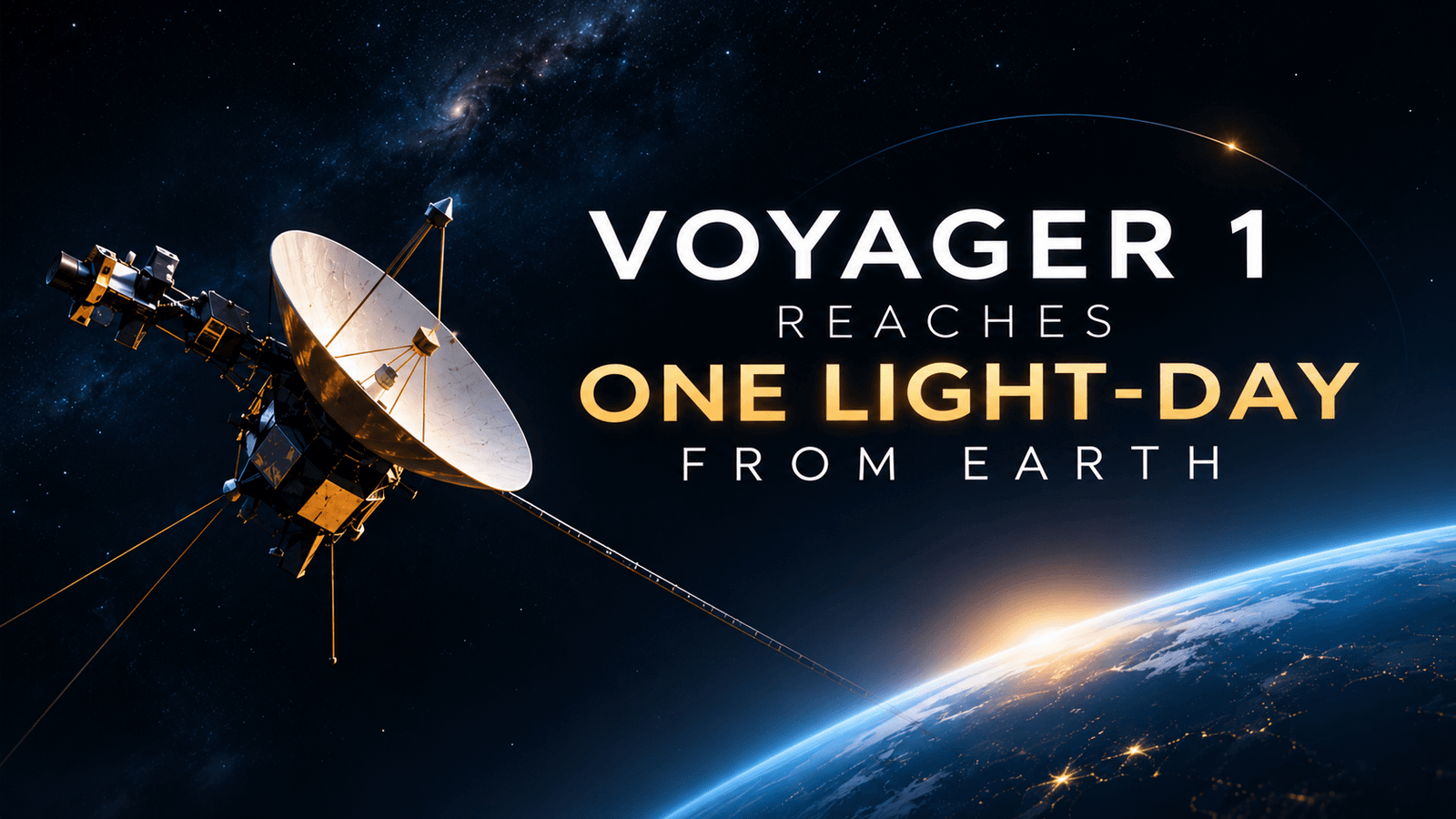
Imagine sending a message to a spacecraft and having to wait an entire day just for that message to reach it. Then imagine waiting another full day for its reply.
That is the extraordinary distance NASA’s Voyager 1 spacecraft is approaching.
Nearly 50 years after leaving Earth, Voyager 1 is set to reach a remarkable milestone on November 18, 2026: one light-day away from our planet. It will become the first human-made object to reach this distance.
But what exactly is a light-day? How far away is Voyager 1? Is it still communicating with Earth? And how does a spacecraft launched in 1977 continue exploring space almost five decades later?
This is more than a story about a distant spacecraft. It is a story about human curiosity, engineering, communication technology and our desire to understand what lies beyond our planet.
Let’s explore.
What Is the Voyager 1 One-Light-Day Milestone?
A light-day is the distance that light travels in 24 hours.
Light travels at approximately 299,792 kilometres per second. At that speed, it covers around 25.9 billion kilometres in one day.
NASA has identified November 18, 2026, as the date Voyager 1 reaches this extraordinary distance from Earth.
Here is what that means:
| Measurement | Distance |
|---|---|
| In kilometres | Approximately 25.9 billion km |
| In miles | Approximately 16.09 billion miles |
| In astronomical units | Approximately 173 AU |
| Light travel time | 24 hours |
| Radio signal travel time to Voyager 1 | Approximately 24 hours |
An astronomical unit (AU) is the average distance between Earth and the Sun, approximately 150 million kilometres.
So Voyager 1 will be roughly 173 times farther from the Sun than Earth is.
And here is the fascinating part: even though light can cover this distance in a single day, Voyager 1 has taken nearly 50 years to travel it.
One light-day is a measurement of distance, not time. It is similar to how a light-year measures distance, except a light-year is the distance light travels in an entire year.
Why Is Voyager 1’s One-Light-Day Achievement So Extraordinary?
Think about the farthest place you have ever travelled from home. Now imagine travelling continuously for almost five decades, without stopping to refuel, repair your spacecraft in person or return to Earth.
That is the kind of journey Voyager 1 has undertaken.
The spacecraft was launched on September 5, 1977, as part of NASA’s Voyager programme. Its original mission was to study the outer planets of our solar system.
It went on to become one of the most successful space exploration missions in history.
Some of its remarkable achievements include:
- Exploring Jupiter and Saturn.
- Capturing extraordinary images of the outer planets and their moons.
- Discovering important details about planetary atmospheres, magnetic fields and moons.
- Becoming the first human-made spacecraft to enter interstellar space in 2012.
- Travelling farther from Earth than any other human-made object.
The mission was originally designed for planetary exploration. Yet Voyager 1 continued far beyond its original destinations, transforming into humanity’s distant messenger.
A Journey That Started in 1977: The Voyager 1 Timeline
To understand the scale of this mission, let’s travel through its history.
1977: The Beginning of an Extraordinary Journey
Voyager 1 launched on September 5, 1977, from Cape Canaveral, Florida.
It was designed to explore the outer solar system and send scientific information back to Earth.
Its twin spacecraft, Voyager 2, launched earlier on August 20, 1977.
1979: Jupiter Flyby
Voyager 1 reached Jupiter in March 1979.
It returned detailed observations of the planet’s atmosphere, magnetic environment and moons. One of the mission’s important discoveries was volcanic activity on Io, a moon of Jupiter.
This changed our understanding of how active moons could be.
1980: Saturn Flyby
In November 1980, Voyager 1 flew past Saturn.
It studied Saturn’s rings, atmosphere and moons, including Titan.
After its Saturn encounter, Voyager 1 continued on a trajectory away from the planetary region.
1990: The Famous Pale Blue Dot
In 1990, Voyager 1 captured one of the most famous images in space exploration history: the Pale Blue Dot.
Earth appeared as a tiny speck of light in an image taken from billions of kilometres away.
The photograph became a powerful reminder of how small our planet looks against the vastness of space.
2012: Entering Interstellar Space
In August 2012, Voyager 1 crossed the heliopause, the boundary where the solar wind’s influence gives way to the surrounding interstellar environment.
It became the first spacecraft to enter interstellar space.
This was a major scientific milestone because Voyager 1 could now study an environment beyond the Sun’s protective bubble of particles and magnetic fields.
2026: The One-Light-Day Milestone
Nearly five decades after launch, Voyager 1 is set to reach one light-day from Earth on November 18, 2026.
It is a new distance milestone for a spacecraft that has continued operating long after its original planetary exploration mission.
What Is Interstellar Space? Has Voyager 1 Left the Solar System?
This is one of the most interesting questions about Voyager 1.
You may have read that Voyager 1 has left the solar system. While it has entered interstellar space, there is an important scientific distinction.
Our Sun creates a vast region of influence called the heliosphere. It is filled with solar wind particles and shaped by the Sun’s magnetic field.
The outer boundary of this region is called the heliopause.
When Voyager 1 crossed the heliopause in 2012, it entered interstellar space.
However, the solar system can also be defined more broadly to include the distant Oort Cloud, a vast, theoretical reservoir of icy objects that may extend much farther from the Sun.
So, while Voyager 1 has left the heliosphere and is travelling through interstellar space, it has not necessarily travelled beyond every object gravitationally associated with the Sun.
What Is Actually Found in Interstellar Space?
Interstellar space is not completely empty.
It contains:
- Hydrogen and helium atoms.
- Interstellar gas and dust.
- Charged particles.
- Cosmic rays.
- Magnetic fields.
Voyager 1’s instruments help scientists investigate this environment and understand the region beyond the heliosphere.
This is one reason the mission remains scientifically valuable.
How Long Does It Take to Send a Message to Voyager 1?
Here is where the one-light-day milestone becomes especially interesting.
Communication with spacecraft depends on radio signals, which travel at approximately the speed of light.
When Voyager 1 is one light-day away:
- A signal sent from Earth takes approximately 24 hours to reach the spacecraft.
- A response sent immediately by Voyager 1 takes another 24 hours to return.
- The minimum round-trip communication time is approximately 48 hours.
That means if mission controllers send a command, they cannot expect an immediate response.
They must plan operations while accounting for this enormous communication delay.
This is very different from communicating with satellites in Earth orbit, where signal travel times are usually measured in milliseconds.
How Does NASA Communicate With Voyager 1?
NASA uses the Deep Space Network (DSN), a global system of large radio antennas designed to communicate with distant spacecraft.
The network has major facilities in:
- California, United States
- Madrid, Spain
- Canberra, Australia
These locations are spread around the planet so that NASA can maintain communication with spacecraft as Earth rotates.
The Deep Space Network sends commands to spacecraft and receives extremely weak radio signals containing scientific data.
As Voyager 1 travels farther away, its signals become increasingly difficult to detect. Communication requires powerful antennas, sensitive receivers and careful signal processing.
It is an extraordinary example of how radio engineering makes deep-space exploration possible.
How Fast Is Voyager 1 Travelling?
Voyager 1 travels at approximately 61,000 kilometres per hour relative to the Sun, although its exact speed and distance depend on the reference frame and measurement date.
That sounds incredibly fast.
To put it into perspective:
- A commercial passenger aircraft typically cruises at around 850–900 km/h.
- Voyager 1 travels at roughly 61,000 km/h.
- Light travels at approximately 1.08 billion km/h.
Even at Voyager 1’s extraordinary speed, it takes decades to reach a distance that light covers in just one day.
This comparison highlights just how enormous interstellar distances really are.
What Is the Golden Record on Voyager 1?
One of the most fascinating things aboard Voyager 1 is the Golden Record.
It is a gold-plated copper record carrying sounds and images intended to represent life and civilisation on Earth.
The record includes:
- Greetings in multiple human languages.
- Sounds from nature.
- Music from different cultures.
- Images showing people, animals and everyday life.
- Scientific information about Earth and humanity.
The idea was to create a message that could represent our planet if the spacecraft were ever encountered by an intelligent civilisation.
Voyager 1 is not expected to meet such a civilisation anytime soon. The Golden Record is primarily a symbolic message from humanity, preserved aboard a spacecraft travelling through interstellar space.
Think of it as a time capsule from Earth, travelling farther than any human-made object before it.
Is Voyager 1 Still Working in 2026?
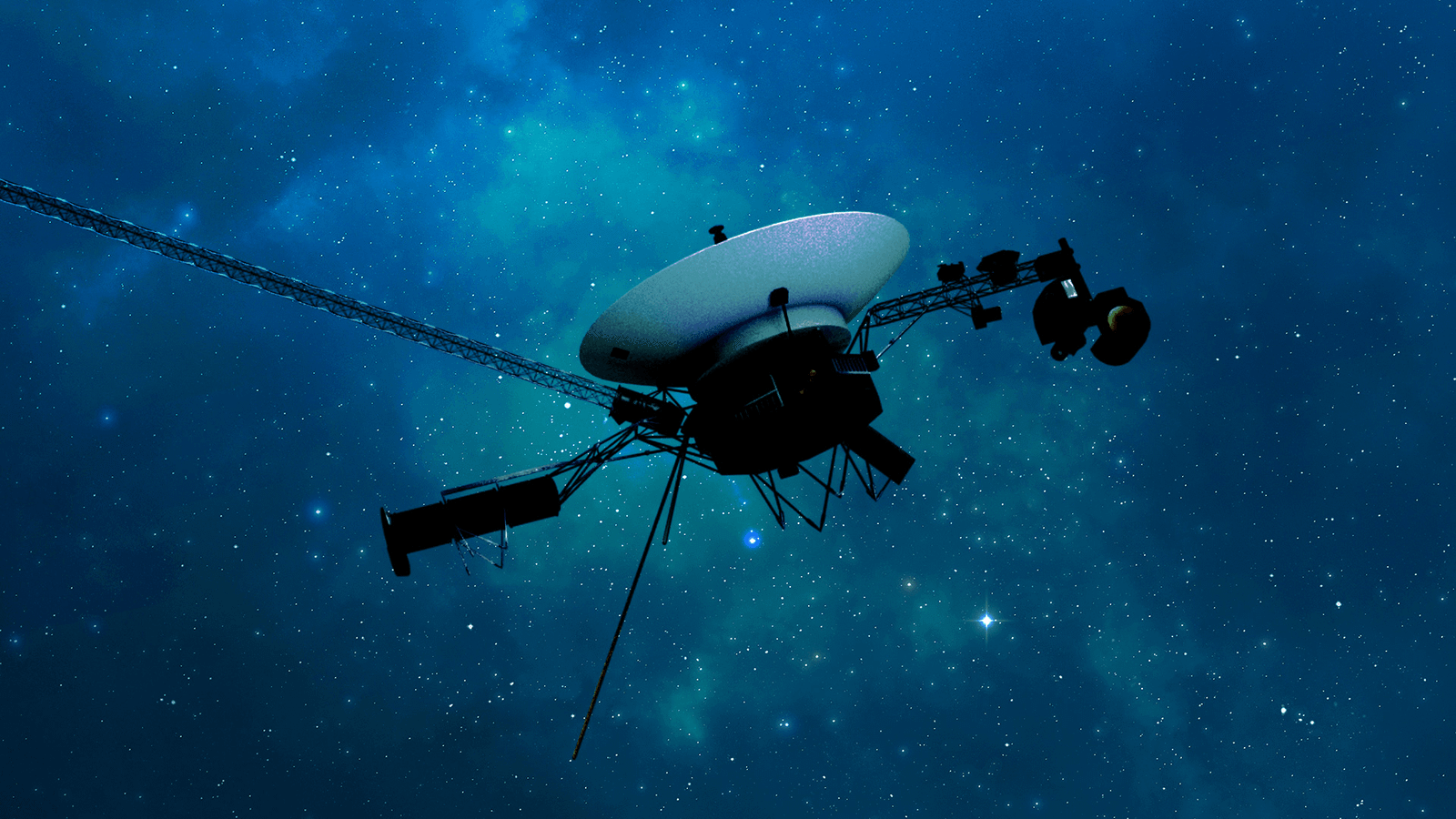
Yes. Voyager 1 remains an active NASA mission, although its systems and scientific instruments have experienced the effects of decades of operation.
The spacecraft was designed using technology from the 1970s. Its onboard computers, power systems and communication hardware are very different from the technology used in modern spacecraft.
Voyager 1 uses radioisotope thermoelectric generators (RTGs) to produce electricity from the heat generated by the natural radioactive decay of plutonium-238.
The available electrical power gradually decreases over time.
To extend the mission, engineers have had to make difficult decisions about which instruments and systems can remain operational.
This is a remarkable engineering challenge: keeping a spacecraft functioning for nearly 50 years, billions of kilometres away, without any physical maintenance.
Voyager 1 vs Voyager 2: What Is the Difference?
Voyager 1 and Voyager 2 are twin spacecraft, but they have travelled along different trajectories and explored different destinations.
| Feature | Voyager 1 | Voyager 2 |
|---|---|---|
| Launch date | September 5, 1977 | August 20, 1977 |
| Jupiter flyby | 1979 | 1979 |
| Saturn flyby | 1980 | 1981 |
| Uranus flyby | No | 1986 |
| Neptune flyby | No | 1989 |
| Entered interstellar space | 2012 | 2018 |
| One-light-day milestone | November 18, 2026 | Expected around 2035 |
Voyager 1 travelled on a trajectory that took it past Jupiter and Saturn before heading into interstellar space.
Voyager 2 continued beyond Saturn and became the first and, so far, only spacecraft to visit Uranus and Neptune.
Both spacecraft are important because they are sampling different regions of interstellar space.
Could Humans Ever Travel as Far as Voyager 1?
This is where science fiction meets real engineering.
Voyager 1 travels at tens of thousands of kilometres per hour. That is extremely fast by human transportation standards, but still very slow compared with the distances between stars.
For perspective, even at Voyager 1’s current approximate speed, reaching the nearest star system would take tens of thousands of years.
Human spaceflight faces additional challenges:
- Protecting astronauts from radiation.
- Providing food, water and life-support systems.
- Developing propulsion systems capable of much higher speeds.
- Maintaining spacecraft systems over extremely long journeys.
- Managing communication delays across interstellar distances.
Future concepts involving advanced propulsion, nuclear technologies and laser-driven light sails are being studied, but interstellar human travel remains an enormous challenge.
Voyager 1 reminds us that reaching another star system is not simply about building a faster rocket. It requires advances across multiple areas of science and engineering.
What Can Students Learn from the Voyager 1 Mission?
Voyager 1 is not just an astronomy story. It is also an incredible engineering case study.
Its journey connects several important areas of science and technology.
1. Aerospace Engineering
Understanding spacecraft structure, trajectories, propulsion and mission design.
2. Electronics and Embedded Systems
Studying how onboard electronics and computers control spacecraft instruments and systems.
3. Radio Communication
Understanding how radio waves transmit information over billions of kilometres.
4. Power Systems
Exploring how spacecraft generate and manage electricity far from the Sun.
5. Data Acquisition and Scientific Instruments
Learning how sensors collect measurements and how scientists interpret data from distant environments.
6. Mission Planning and Systems Engineering
Understanding how multiple subsystems work together during a long-duration mission.These concepts are not limited to large interplanetary spacecraft. Students can explore similar engineering principles through educational satellite projects, sensor payloads and communication experiments.
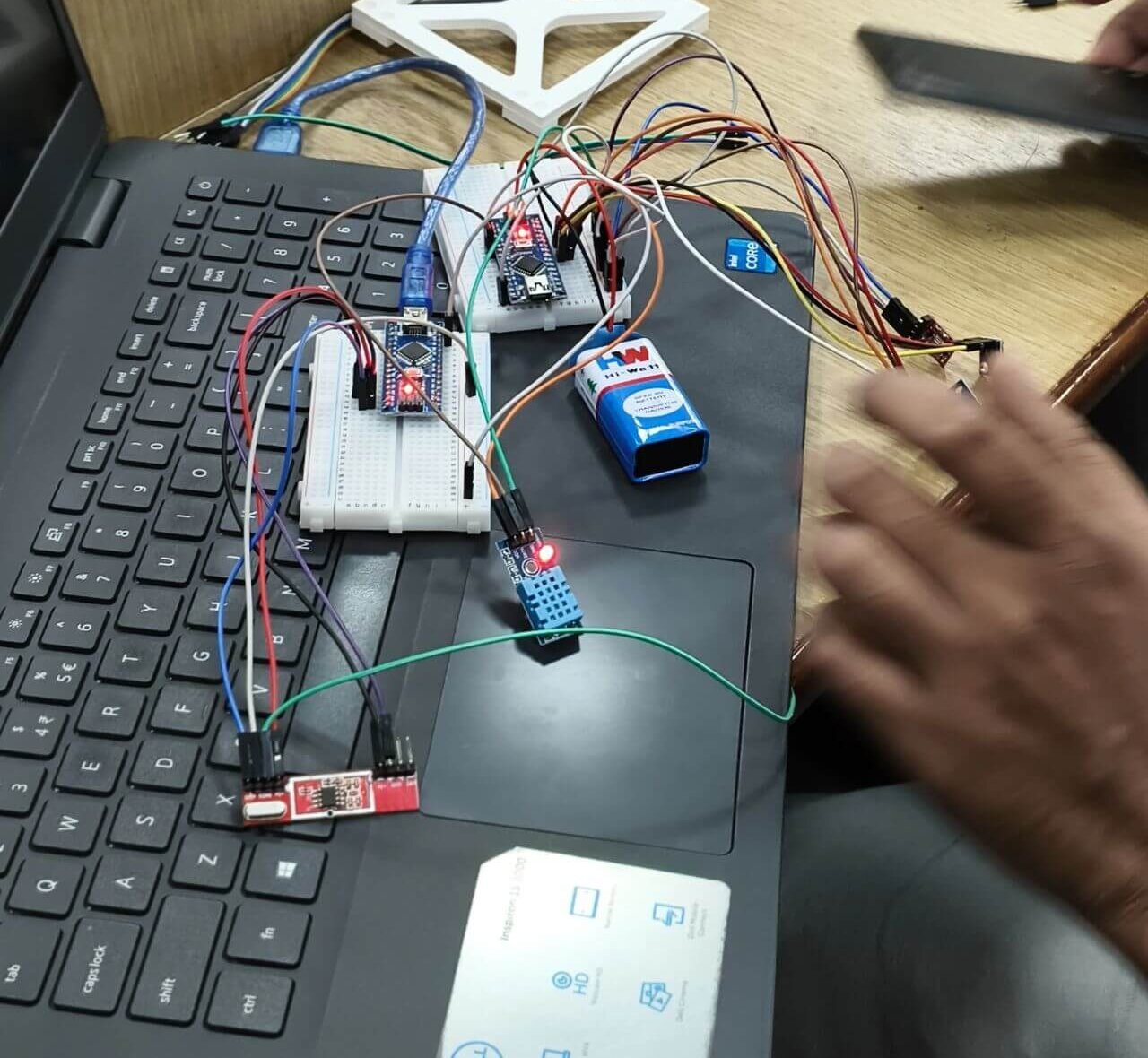
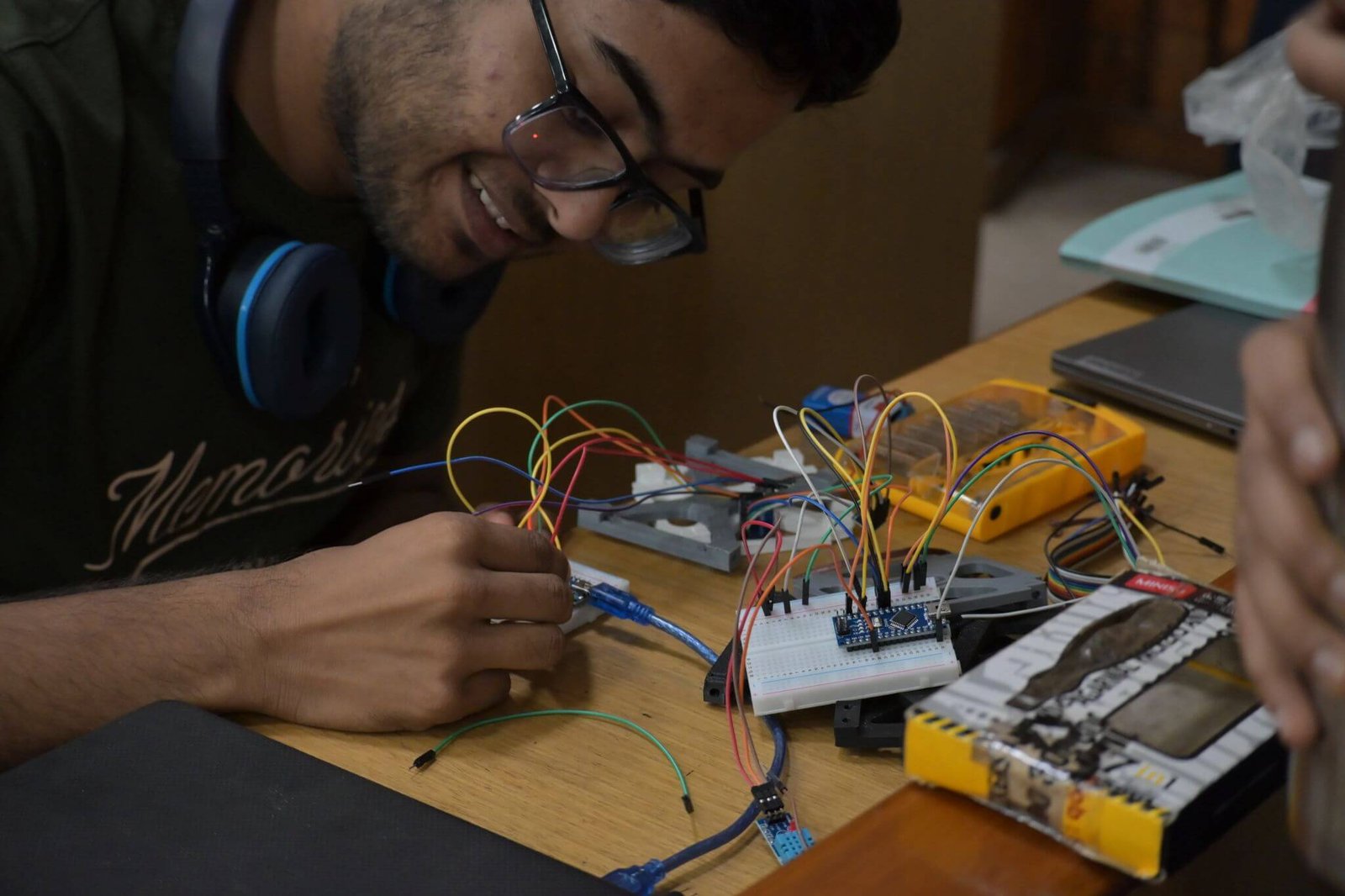
At Hexstar Universe, students can explore satellite engineering through hands-on educational platforms such as the CubeSat Kit and CanSat Kit.
These learning platforms introduce concepts such as sensor integration, telemetry, payload development and real-time data monitoring.
What Happens Next for Voyager 1?
Reaching one light-day is a distance milestone, not the end of the mission.
Voyager 1 will continue moving farther away from Earth while its remaining systems and scientific instruments allow.
Its journey will continue to provide information about the interstellar environment.
Over time, the spacecraft will become increasingly difficult to communicate with as its available power decreases and its signal grows weaker.
But even after it can no longer send scientific data, Voyager 1 will continue travelling through space.
It carries a message from Earth, and its journey will continue long after the people who designed and launched it are gone.
That is perhaps the most extraordinary part of the Voyager mission.
A spacecraft built in the 1970s is still extending humanity’s reach into the universe.
Final Thoughts: A Message from Earth, Travelling Beyond Our Imagination
There is something extraordinary about Voyager 1.
It was built by engineers and scientists using technology from another generation. It launched when personal computers were still a new idea, and it has travelled farther than any other human-made object.
Now, nearly 50 years later, it is reaching a distance where even a message travelling at the speed of light needs an entire day to get there.
The one-light-day milestone is more than a number. It represents decades of scientific curiosity, engineering innovation and the determination to explore beyond what we already know.
For students, researchers and anyone interested in space, Voyager 1 offers an important lesson: some of humanity’s greatest discoveries begin with a question, an experiment and the courage to build something that has never been built before.
We sent a spacecraft into the unknown nearly five decades ago. And it is still telling us what is out there.
Explore more about satellite engineering, payload development and hands-on space technology with Hexstar Universe.
Voyager 1’s one-light-day milestone marks the point at which the spacecraft is approximately one light-day away from Earth. This is the distance light travels in 24 hours, approximately 25.9 billion kilometres or 16.09 billion miles.
NASA has identified November 18, 2026, as the date Voyager 1 reaches one light-day from Earth. The announced milestone time is 10:16 UTC, or approximately 3:46 PM Indian Standard Time.
Voyager 1 is approaching approximately 25.9 billion kilometres (16.09 billion miles) from Earth at the one-light-day milestone. Its distance continues to increase as it travels through interstellar space.
One light-day is approximately 25.9 billion kilometres. It is the distance light travels in 24 hours at approximately 299,792 kilometres per second.
Yes. Voyager 1 is the most distant human-made object from Earth. It has travelled farther than any other spacecraft launched by humanity
At a distance of one light-day, a radio signal travelling at the speed of light takes approximately 24 hours to reach Voyager 1 from Earth.
At one light-day away, a signal takes approximately 24 hours to travel to Voyager 1 and another 24 hours for a response to return. The minimum round-trip communication time is therefore around 48 hours, excluding processing time.
Voyager 1 crossed the heliopause in 2012 and entered interstellar space. However, if the solar system is defined to include the distant Oort Cloud, it has not necessarily travelled beyond the full gravitational extent of the Sun.
Voyager 1 remains part of NASA’s extended mission and continues communicating with Earth when its systems and operating conditions permit. Its available power and functioning instruments are gradually declining.
Voyager 1 travels at approximately 61,000 kilometres per hour relative to the Sun. Its speed is extraordinarily high compared with aircraft, but small compared with the speed of light.
The Golden Record is a gold-plated copper record containing sounds, music, greetings and images representing Earth and human civilization. It was included as a symbolic message for any intelligent civilization that might encounter the spacecraft.
No. Voyager 1 is extremely far away and too faint to be observed using ordinary amateur telescopes. It is tracked through radio communication using NASA’s Deep Space Network.
NASA communicates with Voyager 1 using the Deep Space Network, a global system of large radio antennas located in California, Madrid and Canberra. These antennas send commands and receive weak scientific signals from distant spacecraft.
Voyager 2 is travelling in a different direction and at a lower speed than Voyager 1. NASA estimates that it will reach the one-light-day distance around 2035.
Voyager 1 is attracting attention because it is reaching the unprecedented milestone of one light-day from Earth on November 18, 2026. The achievement highlights nearly five decades of space exploration and the engineering behind humanity’s most distant spacecraft.
NASA’s Shine Bright for Voyager initiative invited people around the world to celebrate the spacecraft’s one-light-day milestone by shining lights skyward and flashing V-G-R, Voyager’s call sign, in Morse code after sunset on November 17, 2026. It was a symbolic global celebration, not a way to establish direct communication with the spacecraft.
Voyager 1 launched on September 5, 1977. By November 18, 2026, it will have been travelling for more than 49 years.
As its power supply declines, Voyager 1 will eventually stop operating its scientific instruments and communicating with Earth. The spacecraft itself will continue travelling through interstellar space.
| Anchor text | Link |
|---|---|
| NASA Voyager Mission | https://science.nasa.gov/mission/voyager/ |
| Where Are Voyager 1 and Voyager 2 Now? | https://science.nasa.gov/mission/voyager/where-are-voyager-1-and-voyager-2-now/ |
| Voyager One Light-Day Downloads | https://science.nasa.gov/resource/voyager-one-light-day-downloads/ |
| Shine Bright for Voyager | https://science.nasa.gov/mission/voyager/voyager-1/shine-bright-for-voyagers-light-day/ |